


Whether training for strength or endurance, running has become a part of most athletes' repertoire. But most athletes also realize that if you want to train effectively, you must do more than just run.
If you're looking for optimal performance in any sport, studies suggest cross-training is essential; runners who cross-train have great efficiency and better performance, and even people who do resistance training have better endurance and aerobic capacity. (1)
That means changing your workouts to constantly challenge your body and trigger better performance adaptations. There are many benefits associated with running and strength training, but the question still stands: is it better to run before or after a workout?
We're doing the legwork for you and giving you all the details on the best time to run.
Key Takeaways
- If building strength and lean muscle mass is your primary goal, run after resistance training to preserve maximum energy for heavier weights and proper form during strength exercises.
- You can do cardio and strength training on the same day. Light warm-ups, yes. But high-intensity endurance training before lifting drains your strength and can lead to muscle imbalances.
- For fat loss, it’s also a good idea to run after the workout. Running post–strength training depletes glycogen stores, forcing your body's energy systems to tap into fat for fuel. Combine both forms of training in your weekly schedule for optimal results.
- Endurance athletes should run first. If boosting cardiovascular endurance is your focus, start your workout routine with running when you have peak energy, and finish with a lighter strength workout.
- Listen to your body and personal preferences. Consider leg day timing, lower body muscle stiffness, and when you feel strongest to structure a routine for long-term success.
What Are Your Fitness Goals?

Before we can help you understand the best time to run, you must clearly define what it is you want to achieve.
Do you want to build muscle? Burn fat? Improve endurance? All athletes will have different goals, and your training program layout will cater to those.
Once you decide what you want to accomplish, warming up with a light cardio workout is generally acceptable, regardless of the end goal.
This is great to get the blood circulating and warm up muscles before putting them under stress to avoid injury or discomfort.
It also helps to increase the flexibility of muscles and joints to prepare them for what's coming, such as a long run or hitting the weights. Research agrees, suggesting that a short cardiovascular warmup decreases the risk of injury. (2)
Low Intensity vs. High Intensity
Remember, warm-up cardio shouldn't be intense, you want to do it at a low intensity to get your body warmed up and ready to perform. Think jumping jacks, light jogging, or dynamic stretches.
If you're heading straight into intense intervals, you risk injuring a muscle and interfering with your weight training.
But when is the best time to do it if you're thinking about high-intensity cardio for a prolonged period? Let's dive in.
If You Want To Build Muscle Mass

For those focused on muscle building, hypertrophy training is your best friend. (9) You want to incorporate progressive overload into your training program by continually increasing the weight and the demand on your muscles; when you force your body to work harder than it's used to, you force it to adapt, and these adaptations cause growth. (3)
Progressive overload can be applied in many forms, such as increasing the load, reps, sets, or decreasing rest periods. Lifting heavy and pushing your body results in microtrauma and inflammation of the muscles, and as part of the muscle repair process, muscle protein synthesis kicks in to cause growth. (4, 5)
Why Muscle Building Requires Smart Timing
But the reason we want to save running for after strength training is that lifting heavy takes energy - and if you deplete your body of energy on the run, your lifts are going to suffer, which means you may not going to hit progressive overload to a high enough degree to stimulate growth.
As a result, the all-important hypertrophic process won't happen, and muscle growth will be minimal.
How Running Affects Lifting Weights Performance
Running before lifting can deplete circulating energy stores required for maximal lifts. Plus, the repetitive movement of running reduces the efficacy of muscle contractions.
On top of less effective muscle contractions, it could compromise form because of the fatigue and repetitive contractions necessary to sustain running. One study found that the number of reps, average power, and velocity significantly decreased in those doing cardio before weight training. (6)
If muscle strength and growth are your goals, aerobic exercise should wait until after your workout.
If You Want To Burn Fat

Similarly, if fat loss is your goal, running after your strength workout is ideal. Lifting first will deplete glycogen stores, which means immediate energy availability will be decreased, forcing your body to tap into alternate stores: body fat during your run.
Building muscle mass is one of the most effective ways to burn fat. Studies show that having a higher percentage of muscle mass increases metabolic rate, thereby helping you burn more calories at rest. (10, 11) Ever heard the saying “muscle burns more than fat”? It's true. So, carve out time to lift heavy if you want to lose weight and burn fat.
How To Combine Cardio for Maximum Fat Loss
That said, running can also boost weight loss, especially during high-intensity intervals, in which you're your body into the “fat burning” aerobic zone whereby you utilize fat for fuel. (7)
You also want to combine cardio sessions - mixing aerobic running with anaerobic running, whereby you're working at 80% of your HRmax or higher; this means your body is performing exercise without oxygen and can only sustain these intensities for short periods.
Alternating between these two forms of training is excellent for triggering excess post-exercise oxygen consumption (EPOC), in which your metabolism remains high for up to 24 hours after you're done training. (8) As a result, you're still burning calories after you've stopped working.
Managing Energy on a Calorie Deficit
If you're on a calorie-deficient diet—optimal for weight loss—your energy levels may be lower than usual. That's why it's a good idea to alternate between running and weight lifting to ensure you don't overwork your body while still reaping the benefits from each.
If you're trying to burn fat by dropping your calories, chances are your energy may take a bit of a hit - that's where having a solid pre-workout can come in handy. A low-caffeine pre workout can naturally boost energy and sustain it to help you easily power through your workout.
If You Want To Improve Your Aerobic Endurance

Lastly, lifting weight is still important to improve running economy and overall performance if your goal is to improve your endurance. Still, you'll want to prioritize running to increase endurance and stamina.
Why Endurance Athletes Should Run First
If you need energy for a run, starting your workout with it is the best way to go; the last thing you want is to start a run feeling fatigued. If your glycogen stores are depleted from a lift, you won't be able to sustain a good running pace, and you'll likely tap out halfway through your run.
Research finds that low glycogen levels hurt endurance performance, which is why you often see runners carb-load before a marathon or big training day - they're maximizing their glycogen stores to maximize performance. Although you may not be running a marathon, you can still apply the same principle to training.
Supplementing With Lifting Weights for Runners
Once you're done with your run, hit the weights for a light workout to work on muscular endurance. Higher reps help to activate type 1 slow-twitch muscle fibers that support running performance, especially over long distances.
Did you know?
Type 1 fibers can sustain work for extended periods, as they have high concentrations of mitochondria and myoglobin to increase aerobic metabolism.
And don't forget proper cool downs after intense sessions to help reduce muscle stiffness and aid recovery.
The Verdict: Run After Resistance Training
If your goals are maximum muscle and strength gains, compromising your lifts by running beforehand probably isn't the best idea.
If you're keen on getting a bit of cardio done after your workout but don't quite have the energy, taking a bit of pre-workout can help re-energize your body and get you pumped up for a quick run.
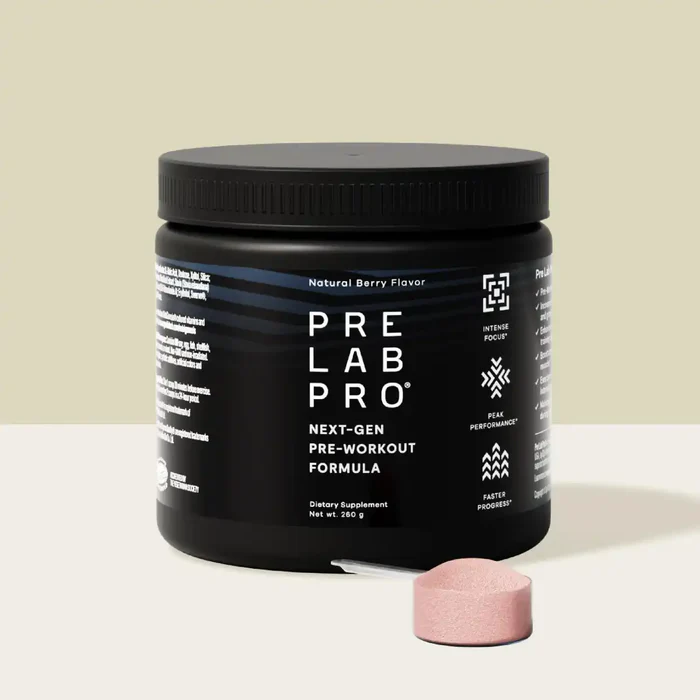
Our recommendation? Pre Lab Pro® . It's a state-of-the-art pre-workout formula designed to excel your results to the next level.

Why Pre Lab Pro® is Our #1 Pre-Workout for Cardio and Strength Training
Whether you're looking to improve muscle growth, speed, endurance, power, or agility, Pre Lab Pro® fires up your body for next-level results with five powerful ingredients plus NutriGenesis® vitamins and minerals.
It provides a bigger nitric oxide boost to build and sustain blood flow to active muscles, giving you a burst of clean energy that enhances strength, stamina, focus, and endurance.
With just 80mg of natural caffeine stacked with L-theanine and nootropics, it supports better energy, focus, and intensity with fewer jitters, crashes, and side effects.
If that's not enough, Pre Lab Pro® extends into the post-workout window to kick-start muscle recovery. And when you're packing it in, you're also getting a good dose of essential nutrients to help you perform at your peak, maintain hydration and electrolyte balance, resist stress, accelerate recovery, and feel great after your session.
It's the ultimate way to fuel your workouts - regardless of what you're doing.
References
- Balsalobre-Fernández C, Santos-Concejero J, Grivas GV. Effects of Strength Training on Running Economy in Highly Trained Runners: A Systematic Review With Meta-Analysis of Controlled Trials. J Strength Cond Res. 2016;30(8):2361-2368.
- Fradkin AJ, Gabbe BJ, Cameron PA. Does warming up prevent injury in sport? The evidence from randomised controlled trials. J Sci Med Sport. 2006;9(3):214-220.
- Geantă VA, Ardelean VP. Improving muscle size with Weider's principle of progressive overload in non-performance athletes. Timisoara Physical Education and Rehabilitation Journal. 2011;14(27):27-32.
- Fortunato AK, Pontes WM, De Souza DMS, et al. Strength Training Session Induces Important Changes on Physiological, Immunological, and Inflammatory Biomarkers. J Immunol Res. 2018;2018:9675216.
- MacDougall JD, Gibala MJ, Tarnopolsky MA, MacDonald JR, Interisano SA, Yarasheski KE. The time course for elevated muscle protein synthesis following heavy resistance exercise. Can J Appl Physiol. 1995;20(4):480-486.
- Ratamess NA, Kang J, Porfido TM, et al. Acute Resistance Exercise Performance Is Negatively Impacted by Prior Aerobic Endurance Exercise. J Strength Cond Res. 2016;30(10):2667-2681.
- Carey DG. Quantifying differences in the “fat burning” zone and the aerobic zone: implications for training. J Strength Cond Res. 2009;23(7):2090-2095.
- Moniz SC, Islam H, Hazell TJ. Mechanistic and methodological perspectives on the impact of intense interval training on post-exercise metabolism. Scand J Med Sci Sports. 2020;30(4):638-651.
- Arı U, Ulupınar S, Özbay S. Effects of resistance training with and without post-exercise aerobic activity on strength and body composition according to individual goals. BMC Sports Sci Med Rehabil. 2025;17(1):311. Published 2025 Oct 28. doi:10.1186/s13102-025-01256-6
- Havers T, Held S, Schönfelder M, Geisler S, Wackerhage H. Effects of Skeletal Muscle Hypertrophy on Fat Mass and Glucose Homeostasis in Humans and Animals: A Narrative Review with Systematic Literature Search. Sports Med. 2025;55(8):1867-1885. doi:10.1007/s40279-025-02263-w
- Theodorakis N, Kreouzi M, Pappas A, Nikolaou M. Beyond Calories: Individual Metabolic and Hormonal Adaptations Driving Variability in Weight Management—A State-of-the-Art Narrative Review. Int J Mol Sci. 2024;25(24):13438. Published 2024 Dec 15. doi:10.3390/ijms252413438