
If you've ever looked into keto or intermittent fasting, you've likely heard something about MCT oil. Medium chain triglyceride foods mainly include coconut oil and palm oil, while MCT oil is a purified form made from these sources that concentrates the medium-chain fats most often used for quick energy, especially caprylic acid (C8) and capric acid (C10).
MCTs are a great addition to the diet because they can be used for quick energy—both in the form of energy-dense fat but also in their conversion to ketones if you're following a ketogenic diet. That makes them especially relevant for health-conscious readers focused on weight loss, metabolic health, steadier energy, or better appetite control.
Based on their role in the body, you can think of MCT oil as the premium fuel you get at a gas pump; the better fuel (energy) you put into your body, the faster and better your car (body) will perform.
So, what about MCT oil for weight loss—does it help or hinder it?
That's exactly what we're going to explore! This article tackles what MCTs are, where they come from, how MCT oil differs from coconut oil and other fats, why they may support thermogenesis and fat loss, and how to use MCT oil effectively if you're trying to lose weight.
Key Takeaways
- MCT oil is a fast burning fat that can be converted to quick energy and ketones, which may help support fat loss and stable energy levels.
- Replacing some dietary fats with MCTs can slightly increase calorie burning and support appetite control when combined with a sensible diet.
- It works best as part of a broader weight management plan that includes whole foods, protein, and regular activity rather than as a magic fix.
- Starting with small doses and building up helps minimize digestive discomfort while you find your ideal daily amount.
What are Medium Chain Triglycerides (MCT)?
MCTs are a type of saturated fatty acid native to coconut and palm kernel oil, unlike most fats, which are long-chain triglycerides, and they’re also found in some dairy products; palm kernel oil provides about 7 to 8 grams of MCTs per tablespoon. While it's primarily derived from coconut oil, it's not the same; it contains a different profile of fatty acids that give it its unique properties.
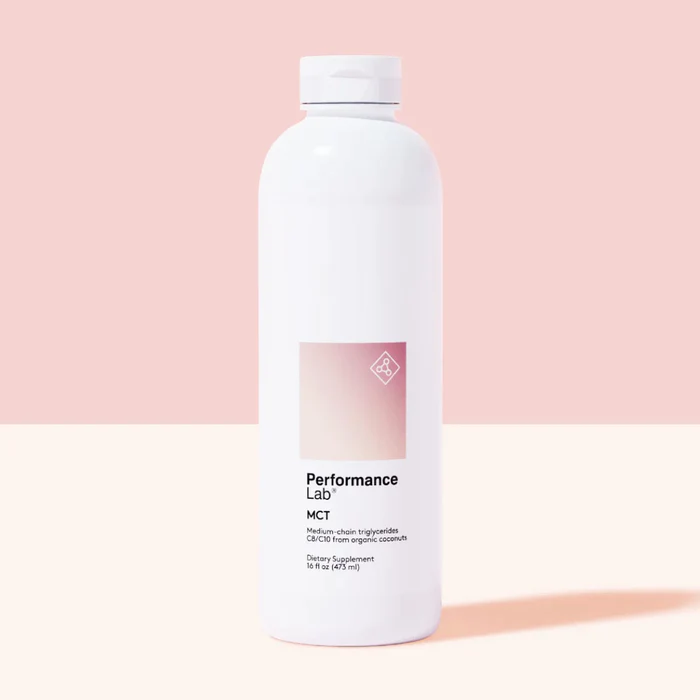
The MCT oil you'll find on shelves is made from pure MCTs extracted from whole food oils by a process called fractionation (isolating specific fatty acids), and MCT oil is easier to digest than long-chain triglycerides because it is absorbed more directly. Most MCT oils—including Performance Lab MCT—are a blend of C8 and C10 fats, but they can also come in 100% caprylic acid or capric acid.
Typically, though, the main types of MCTs are caproic acid (C6), caprylic acid (C8), capric acid (C10), and lauric acid (C12), though you'll often find shelf blends containing anywhere from 50 to 80% caprylic acid and 20-50% capric acid. Caprylic acid tends to be the predominant fat in MCT oil because its shorter length is absorbed more rapidly than capric acid.
But when you find a high-quality MCT oil, caproic acid (C6) and lauric acid (C12) are generally removed for palatability and absorption purposes.
Let's quickly look at a bit of a side note on comparisons of fatty acids:
Short-chain fatty acids (SCFAs) comprised of 0-5 carbons are both produced in the gut and consumed through food and contribute to gut health by fermenting fiber in the colon; they provide energy for cells lining your colon 1.
Long-chain fatty acids (13-21 carbons) are consumed through food sources and are found in fatty foods and oils; they are preferentially metabolized in the intestine, where they're incorporated into chylomicrons before being utilized or stored 2.
MCTs (6-12 carbons), on the other hand, are absorbed intact, transported to the liver intact, and are preferentially available for hepatic mitochondrial β-oxidation (i.e., energy production).
MCTs are also found in food sources, but what separates them from other fats is how they're processed by the body, which is why they're touted for being so beneficial for weight loss.
MCT vs. Coconut Oil
As one of the primary mct rich foods, coconut oil provides about 8 to 14 grams of MCTs per tablespoon, but it doesn't have the same metabolic properties as pure MCT oil; coconut oil comprises about 60% MCTs while pure MCT is 100%.
It also contains a large percentage of lauric acid (C12), which isn't absorbed efficiently, unlike caprylic and capric acid. Some studies suggest that lauric acid behaves more like a long-chain fatty acid, which means it requires digestion in the liver before being utilized, though lauric acid also has antibacterial properties.
That said, coconut oil still offers health benefits and may support weight management and metabolic health while helping improve energy levels and mental clarity.
Why is MCT Beneficial For Weight Loss?
When it comes to weight loss, MCT seems to be the fat that helps you lose fat. It has several benefits for weight management that make it a great weight loss aid. Let's explore the best benefits:
- Thermogenesis—MCTs appear to induce thermogenesis—the generation of heat in the body, which means they could help burn calories, even at rest. In one study, researchers fed six lean and six obese young males meals containing 38g of fat in the form of LCTs or MCTs plus LCTs 3. In both lean and obese subjects, postprandial thermogenesis was increased after consuming meals containing MCTs. Another study found that daily consumption of 20g of MCT in overweight participants resulted in lower body weight at the end of the experimentation period compared to participants consuming the same amount of olive oil 4. The group consuming MCTs also had lower total fat mass. While a slight increase in energy expenditure may not play a substantial role in weight loss, there is support that MCTs can help mitigate declining metabolic rates and decreased energy levels that often result from calorie restriction when trying to lose weight.
- Increased Energy Production—Since MCTs are readily oxidized in the liver, they provide a rapid energy source in the form of fat and ketones. One study looked at the effects of energy expenditure in people consuming MCT oil or corn oil and found that despite following the same diet (15% protein, 55% carbohydrates, 30% fat), the group consuming MCT had a 65% greater energy expenditure than those consuming corn oil with just a 48% increase 5. Essentially, MCTs can help you burn more calories while eating the same amount of food.
- Rarely stored as fat—Because of the unique way they're metabolized, MCTs are rarely stored as fat; they are oxidized to a greater extent than LCTs, which means they have less opportunity for deposition into adipose tissue 6 and may support lower body fat over time. Now, this doesn't give you a free pass to consuming all the MCT oil you want because it still comes with a calorie tag, but it safeguards you slightly against the possibility of packing on fat if you consume too much.
- Regulate appetite—Fats have always been known to be satiating because they're more energy-dense and take longer to digest than carbs. But it seems like MCT may be on its own pedestal. Several studies have found that MCTs increase satiety more than LCTs, and while it was traditionally thought to result from altered gut hormones, some research suggests it may actually be because of the thermal and oxidative pathways that enhance thermogenesis and satiety, thereby reducing energy intake 7. But MCTs have also been shown to improve insulin sensitivity, which means better blood glucose regulation, fewer blood sugar fluctuations, and fewer cravings and raging hunger. Some research also suggests MCT oil may help lower LDL cholesterol levels, but more research is needed on its broader potential benefits.
How To Use MCT For Weight Loss
There's a lot to talk about with MCTs, but it's pretty simple for the purposes of weight loss—clean up your diet and start consuming MCT. But remember that you can't add MCT into a dirty diet expecting it to work miracles.
MCT oil subs in as an excellent replacement for the long-chain fatty acids naturally consumed in your diet (avocado oil, olive oil, etc.), but it's best to add mct oil to an otherwise balanced diet with other healthy fats, and when you're looking towards MCT for weight loss, you have to keep one thing in mind: the dose.
The exact amount you consume for weight loss will ultimately come down to staying within your energy needs (calories), because despite being a powerful source of energy that rarely gets stored as fat, MCT is still a fat and therefore still contributes to your daily energy intake.
I know we all wish that we could gorge ourselves on calorie-burning foods and still lose weight, but unfortunately, it doesn't work like that.
While weight-loss boils down to more than just calories in vs. calories out, understanding your energy needs is vital because if you're eating more than you're burning, you're going to struggle to lose weight.
Based on available research, it seems that 1-2 tbsp (15-30g) daily is enough to elicit many MCT oil benefits in conjunction with a slightly calorie-reduced diet.
You also have to remember that if you've never taken MCT before, too large a dose can cause some pretty unpleasant GI effects like abdominal pain, cramping, and diarrhea, so it's always best to start with one teaspoon and work your way up to the desired amount.
Add MCT oil to coffee for energy—bulletproof coffee is a common option for people following a low carb diet—or use it raw in smoothies and salad dressings.
Because it has a low smoke point, avoid high-heat cooking with it.
If you're looking to include a couple of tablespoons daily, it may be best to break it up into 2-3 servings to avoid any side effects.
Final Thoughts
In the world of fats, MCTs are a standalone star, and beyond pure oil, mct foods and other foods that naturally provide medium chain triglycerides can also support balanced nutrition. Whether it's cognitive health and immune function, or heart health and athletic performance, they're pretty much a superstar in the fat world.
But when it comes to weight loss, MCTs perform. They help increase energy expenditure, boost energy levels, and regulate appetite to help you consume less, burn more, and achieve your goals, while dairy options like whole milk and butter also supply modest amounts of these healthy fats and beneficial fats, with whole milk providing roughly 4% to 10% of its fat as MCTs and butter about 8% of total fat, along with fat soluble vitamins that can support bone health, brain health, and heart and brain health, though anyone with heart disease or high cholesterol should consider total saturated fat intake. Goat milk contains more MCTs than cow's milk, and butter from grass fed cows provides about 0.7 grams per tablespoon, while milk choices like these can add small amounts alongside a broader routine built around a pure, high-quality MCT oil like Performance Lab MCT, so you know it's time to upgrade!
References
SI Cook, JH Sellin. Review article: short chain fatty acids in health and disease. Aliment Pharmacol Ther. 1998;12(6):499-507. https://doi.org/10.1046/j.1365-2036.1998.00337.x
C Beermann, J Jelinek, T Reinecker, A Hauenschild, G Boehm, HU Klör. Short term effects of dietary medium-chain fatty acids and n-3 long-chain polyunsaturated fatty acids on the fat metabolism of healthy volunteers. Lipids Health Dis. 2003;2:10. https://doi.org/10.1186/1476-511X-2-10
L Scalfi, A Coltorti, F Contaldo. Postprandial thermogenesis in lean and obese subjects after meals supplemented with medium-chain and long-chain triglycerides. Am J Clin Nutr. 1991;53(5):1130-1133. https://doi.org/10.1093/ajcn/53.5.1130
MP St-Onge, A Bosarge. Weight-loss diet that includes consumption of medium-chain triacylglycerol oil leads to a greater rate of weight and fat mass loss than does olive oil. Am J Clin Nutr. 2008;87(3):621-626. https://doi.org/10.1093/ajcn/87.3.621
MP St-Onge, PJ Jones. Physiological effects of medium-chain triglycerides: potential agents in the prevention of obesity. J Nutr. 2002;132(3):329-332. https://doi.org/10.1093/jn/132.3.329
MP St-Onge. Dietary fats, teas, dairy, and nuts: potential functional foods for weight control? Am J Clin Nutr. 2005;81(1):7-15. https://doi.org/10.1093/ajcn/81.1.7
MP St-Onge, B Mayrsohn, M O'Keeffe, HR Kissileff, AR Choudhury, B Laferrère. Impact of medium and long chain triglycerides consumption on appetite and food intake in overweight men. Eur J Clin Nutr. 2014;68(10):1134-1140. https://doi.org/10.1038/ejcn.2014.145